Aug 14 • RestoreTech 360 Team

How to Renew IICRC Certifications for High-Volume Commercial Technicians Without Downtime

Learn how to renew IICRC certifications with a staggered schedule, annual fees, and IICRC CEC credits. Keep commercial crews on-call.

Key Takeaways

  • You can renew IICRC certifications by aligning annual fees and IICRC CEC credits to a rolling, crew-based schedule

  • A staggered renewal calendar prevents coverage gaps while keeping on-call operations fully staffed

  • A simple tracking system reduces missed deadlines and last-minute training scrambles

Keep your large-loss crew certified without pulling them off the schedule

Picture a week of back-to-back losses: a hospital wing flood on Monday, a retail warehouse on Wednesday, then an overnight callout on Friday. Right in the middle, two lead techs realize they are due for renewal and your only “plan” is squeezing classes in whenever the phones stop ringing.

A practical target is 0 missed deadlines and 2–4 CEC hours per month per tech so renewals happen gradually instead of turning into a scramble late in the year. By the end of this section, you will have a renewal workflow that fits rotating on-call coverage without leaving a job short-staffed.

Also, treat renewals like coverage planning, not like training time you will “find later.” If you do one thing, make it this: set a monthly CEC cadence per tech and protect it on the calendar the same way you protect on-call rotations.

Use this simple workflow to keep certifications moving while jobs keep moving:

  • Set the minimum monthly commitment: 2–4 CEC hours per month per tech (often 30–60 minutes per week)

  • Attach learning to low-risk time blocks: early shift start, end-of-day wrap-up, or the second half of a standby weekend

  • Always keep one lead tech “appointment-free”: if your large-loss response needs 2 leads on a job, schedule CEC time for only one lead during that week

  • Build a swap rule: if an emergency call comes in, the tech reschedules within 7 days so the month does not slip

But there is a tradeoff: this works best when your learning blocks are short and frequent, and it fails when you try to do “one 6-hour day” during a busy season. Long blocks get cancelled first, then the renewals pile up.

A common mistake is reserving time only for the people who ask for it, which leaves steady performers behind until the due date is close. Fix it by pre-booking a repeating block for every tech, then letting them trade times within the same week so coverage stays intact.

If you’re short on time, skip building a complex quarterly plan and do this instead:

  • Pick one repeatable weekly slot per tech (30–60 minutes)

  • Protect the slot for the next 8 weeks

  • Review every two weeks to confirm no one is drifting below the 2–4 hours per month target

In practice, the goal is not perfect attendance, it is a reliable pace. When every tech chips away at CECs monthly, renewals stop being a surprise that steals your best people during your busiest calls.

Confirm what each technician needs to renew

Next, get the facts on one sheet per technician before you touch the calendar. If you do one thing, make a simple renewal inventory that shows what they hold, what expires soon, and what it will cost, because guessing leads to last-minute scrambling and unplanned time off.

For each technician, list:

  • Each IICRC certification held (for example: WRT, ASD, AMRT)

  • Renewal date (month and year is often enough for planning)

  • Annual fees and who pays (tech, branch, or corporate)

  • Required IICRC CEC credits for the renewal cycle and how many are already completed

  • Where proof lives (email confirmation, PDF certificate, learning portal screenshot)

A common mistake is tracking only the expiration date. The fix is to also track CECs and fees, because a tech can be “expiring in 90 days” but still need, for example, 6 to 10 CEC hours they have not started yet.

Also, write down the constraints that make renewals hard for your specific crew. These details are what keep a training plan from colliding with production.

Constraints to capture per technician:

  • On-call rotation weeks (avoid scheduling courses during those weeks)

  • Travel windows (for example, catastrophe travel or regional coverage weeks)

  • Project peaks (month-end billing pushes, seasonal surge periods, large-loss ramp-ups)

  • Blackout dates (pre-scheduled PTO, court dates, mandatory safety training, warehouse inventory days)

Works best when you treat this as a living list you review weekly for 10 minutes. It fails when it becomes a once-a-year spreadsheet that nobody updates after the first emergency water loss hits.

Build a no-downtime renewal schedule for high-volume crews

Next, treat renewals like shift planning: predictable, staggered, and visible to anyone who builds the schedule. If you push everyone to renew in the same quarter, you usually get either missed deadlines or a sudden training pileup that steals hours from billable work.

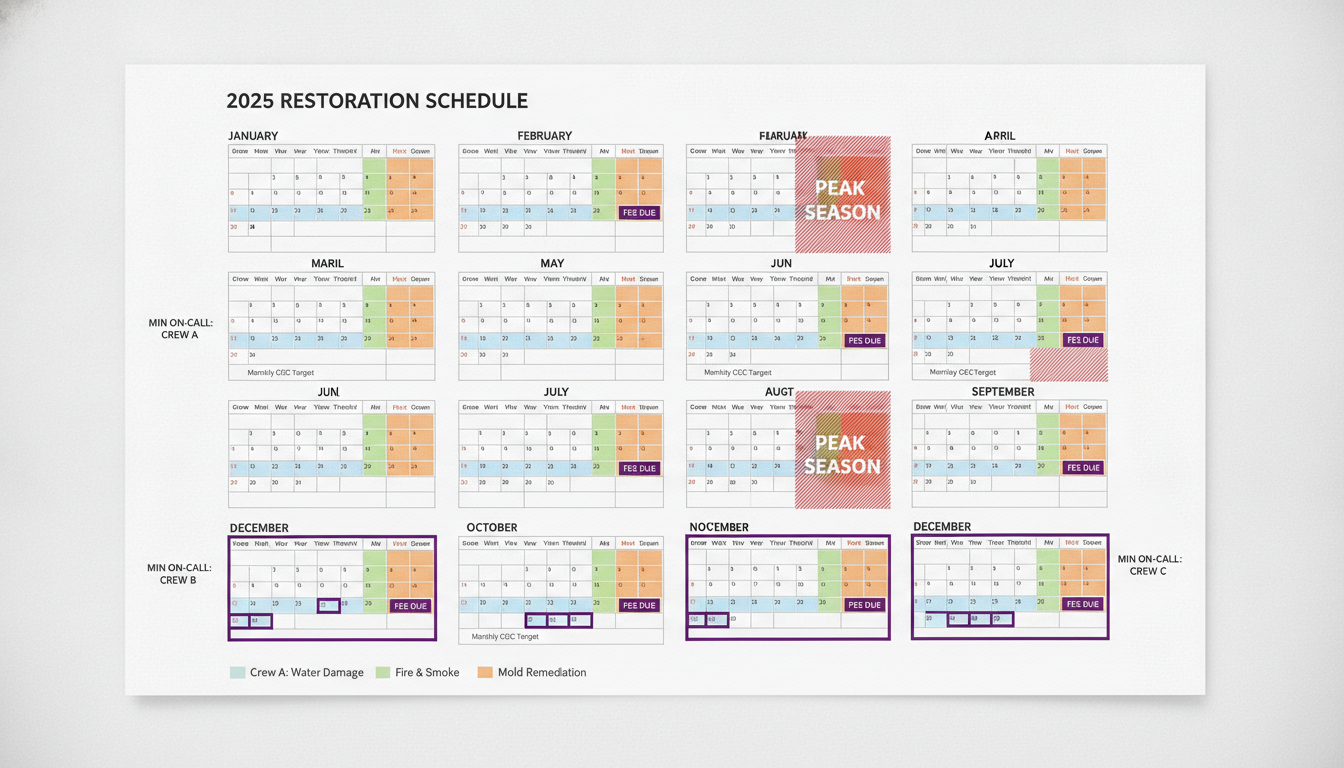
Start with a staggered cadence by splitting the team into cohorts (for example, three groups of 8 to 12 techs, or by role such as crew leads, equipment techs, and contents). Give each cohort a monthly CEC target and a fee window so progress stays steady and you avoid last-minute payments. If you do one thing, do this: assign targets that fit real capacity, such as 1 to 2 CECs per tech per month during slower periods, and near zero during your busiest weeks.

Create a 12-month calendar that blocks off peak season and guarantees minimum on-call coverage. A practical rule is to schedule any in-person training or longer webinars only when you can still keep at least one full crew and one lead on call per shift, then rotate who is “training eligible” that month. Common mistake: planning CECs without tying them to staffing, then canceling last minute and losing momentum. Fix it by adding two simple gates to your calendar:

  • A coverage check (who is on call, who is off limits)

  • A fee window (who pays this month, who pays next month)

If you’re short on time, skip building a perfect plan and do a simple version: three cohorts, one monthly CEC number, and one payment week per month. This works best when your dispatch volume is predictable; it fails when you have frequent surge events, so keep a buffer month where no one is scheduled for anything except make-up hours and late fees.

Execute and track renewals with a lightweight system

Next, the goal is simple: make renewals automatic enough that nothing expires quietly, but light enough that it does not become a second job.

Start with three reminders per technician: 90, 60, and 30 days before any renewal fee or CEC deadline. Put all technician records in one shared list (spreadsheet, HRIS notes, or a basic task tool) and assign one owner per technician record so follow-ups never get lost between operations, HR, and project managers.

Use this quick checklist inside each technician record:

  • Renewal date (month/day)

  • Fee status: not started, submitted, paid

  • CEC target vs earned (for example, 14 of 20 hours)

  • Missing proof (receipt, certificate, attendance record)

  • Next action and due date

Here’s the catch: reminders work best when they point to a specific action and a person. They fail when the reminder is only “renew soon” and it goes to a group inbox with no clear next step.

Run a 15-minute monthly renewal standup to keep the list clean and decisions fast. Keep it to three questions per technician coming due in the next 60 to 90 days: what is the deadline, what is the CEC gap, and what coverage plan keeps them on the schedule.

If you do one thing, do this: leave the standup with one named owner and one dated next step for every upcoming renewal. Common mistake: tracking CECs only at the 30-day mark, then scrambling for class seats or documentation. Fix it by using the 90-day reminder to confirm progress and book anything that needs lead time.

Closing remarks

The best time to renew is when you’re not scrambling. When renewals wait until the week a tech is needed on a large-loss job, the cost is not just fees, it is missed revenue, rushed paperwork, and a crew lead stuck doing admin at 9 pm.

If you do one thing after reading this, pick the smallest repeatable action and put it on the calendar this week. Which single change would most reduce downtime risk for your crew: cohort scheduling, monthly CEC targets, or tighter tracking?