RestoreTech 360 Team
Aug 13

How to Use the IICRC CEC Course Search Before You Enroll Online

Key Takeaways

  • Use the IICRC CEC Course Search to confirm a course is approved and see eligible credit hours before paying

  • Distinguish between online training listings, scheduled classroom events, and the CEC provider directory so you search the right place

  • Verify the provider and save completion documentation to avoid renewal delays or rejected CEC submissions

Avoid paying for the wrong CEC course by verifying it first

You find a “CEC approved” online class that looks perfect, but something feels off: the course title is close to what you need, the credit hours are unclear, or the provider name doesn’t match what your renewal paperwork expects. That’s how people end up paying for a course that does not count the way they thought it would.

Next, plan for 5–10 minutes to verify the course, the provider, and the credit hours before you enroll. By the end of this section, you will have a repeatable checklist you can run every time, even if you are signing up on your phone between jobs.

A quick verification checklist you can reuse every time

But do not rely on the words “CEC approved” on a sales page alone. If you do one thing, confirm the exact course listing in the official search results first, then compare it to what the provider is selling.

Use this 5–10 minute check before paying:

  • Match the course title word-for-word (not “close enough”)

  • Confirm the course ID or code if one is shown in the listing

  • Check the credit hours and make sure they meet your renewal requirement (for example, 8 hours vs 14)

  • Confirm the course category or topic aligns with what you still need (for example, water vs fire vs safety)

  • Verify the provider name matches exactly, including abbreviations (for example, LLC vs Inc)

  • Check the delivery format you are enrolling in matches the listing (online, in-person, or hybrid)

  • Note any limits that could make it invalid for you (for example, region restrictions or expiration)

Here’s the catch: this works best when you verify before checkout, and it fails when you try to fix a mismatch after you have completed the class. A common mistake is assuming “approved” means “approved for my exact renewal need”; the fix is to compare the listing details to your renewal gap first, then enroll.

Choose the right IICRC search path for what you need

Next, avoid wasting time in the wrong directory by picking the lookup that matches your exact goal.

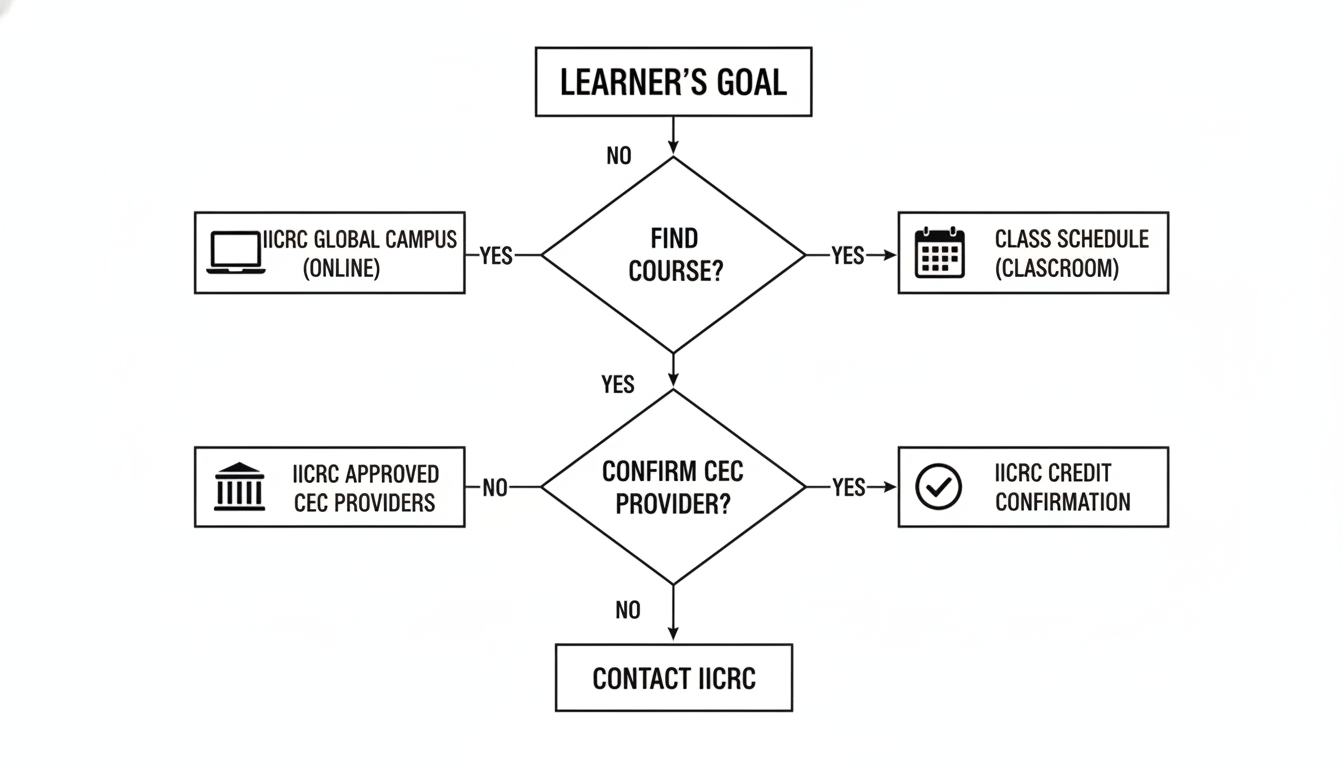
The IICRC site gives you four different ways to check CEC info, and each answers a different question. If you start with the wrong one, you can end up thinking a course is missing, a provider is not approved, or credits will not count when they actually will.

The four IICRC lookups and what each one is for

  • Online training search: use this when you want a self-paced or online option and need to see whether the course is eligible for CECs

  • Scheduled classroom CEC training: use this when you need an in-person class with a specific date, city, or region

  • CEC provider directory: use this when you want to confirm the company offering the training is an approved provider

  • Verification steps: use this when you need to confirm the credits, course listing, and record details are consistent before you pay

Common mistake: relying on a provider’s marketing page alone. Fix: cross-check the course and the provider in the IICRC listings, then save proof before you enroll.

Match your goal to the right path

So, start by naming your goal in one sentence, then pick the lookup that answers it.

  • You are a technician renewing certifications and need a fast, online option this week: start with online training search

  • You are a supervisor planning travel and need a class in the next 30 to 60 days: start with scheduled classroom CEC training

  • You are a training coordinator buying seats for a team of 5 to 20: start with the CEC provider directory, then check the course listing

  • You already took a course and need to confirm the credits will count: start with verification steps and keep screenshots of what you find

If you do one thing, do this: pick the lookup based on your goal before typing keywords. It works best when your goal is specific, and it fails when you search broadly without a date, format, or provider in mind.

Run an accurate search and confirm the course details match your needs

Next, run your search like you are trying to prove the course is right, not just hoping it is.

If you do one thing, do this: copy the exact course title (and any course number) from the sales page and search it directly. If the listing does not appear with an exact match, treat that as a warning sign and pause before paying.

Use search terms that surface the official listing

Also, keep your terms specific so you do not get outdated or unrelated pages. These are the phrases that usually bring up the right results faster:

Here’s the catch: broad terms like “IICRC CEC” can return provider blog posts, old PDFs, or marketing pages that look official. When you find a result, open it and confirm it is the actual course listing, not a directory summary.

Confirm the fields that decide whether your credits count

So, verify the details that matter to your renewal before you enroll. A 2-minute check now can save you hours of back-and-forth later, especially if you are renewing close to your deadline.

Check these fields line by line:

  • Course title matches the sales page (watch for “v2”, “2024 update”, or similar variants)

  • Delivery format matches what you need (online, in-person, live webinar, self-paced)

  • Credit hours match your target (for example, if you need 14 total hours, a 7-hour course only gets you halfway)

  • Expiration status is valid (avoid expired or discontinued listings)

  • Prerequisites are clear (for example, an applied course may expect a prior certification or a specific class)

Common mistake: buying based on the provider’s checkout page name (which may be shortened) instead of the official listing title. Fix: match the exact title word-for-word, then keep a screenshot or PDF of the listing for your records.
Verify the provider and protect yourself with documentation

Next, treat the provider check like a safety step before you pay. In the IICRC continuing education provider directory, confirm the training company is listed, then match the provider name and address to what you see on the course listing so you know it is the same organization.

A common mistake is assuming a similar name is close enough, especially when a course page is run by a marketing partner or a separate branch office. Works best when everything matches exactly (provider name, location, and course details), fails when any one of those items is vague or missing.

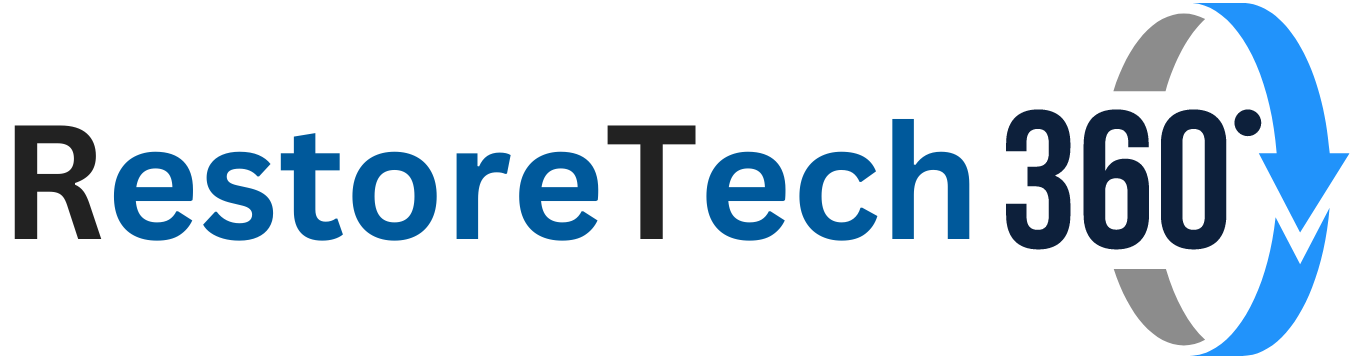
So, once you enroll and complete the course, keep renewal proof in one place in case you need to verify hours later. If you do one thing, save a PDF or screenshot of the approval details the day you register because listings can change.

Save these items for your renewal records:

  • Screenshot or PDF of the approval details in the directory (provider and course)

  • Enrollment receipt showing what you paid and the date

  • Completion certificate with your name and completion date

  • Course hours or CECs shown on the certificate or completion page

  • Any email confirmation that includes the course title and provider name

If you're short on time, at minimum save the certificate and the approval details screenshot, then add the receipt later when you reconcile payments.

Closing remarks

So before you click enroll, pause for a quick final check: Trust, but verify—especially when credits affect your renewal.

A good next step is to decide what you will verify today (course title, credit type and amount, approved provider status), and where you will store your proof so it is easy to find later. For example, keep a single folder with a dated screenshot of the listing, the course confirmation email, and your completion certificate.