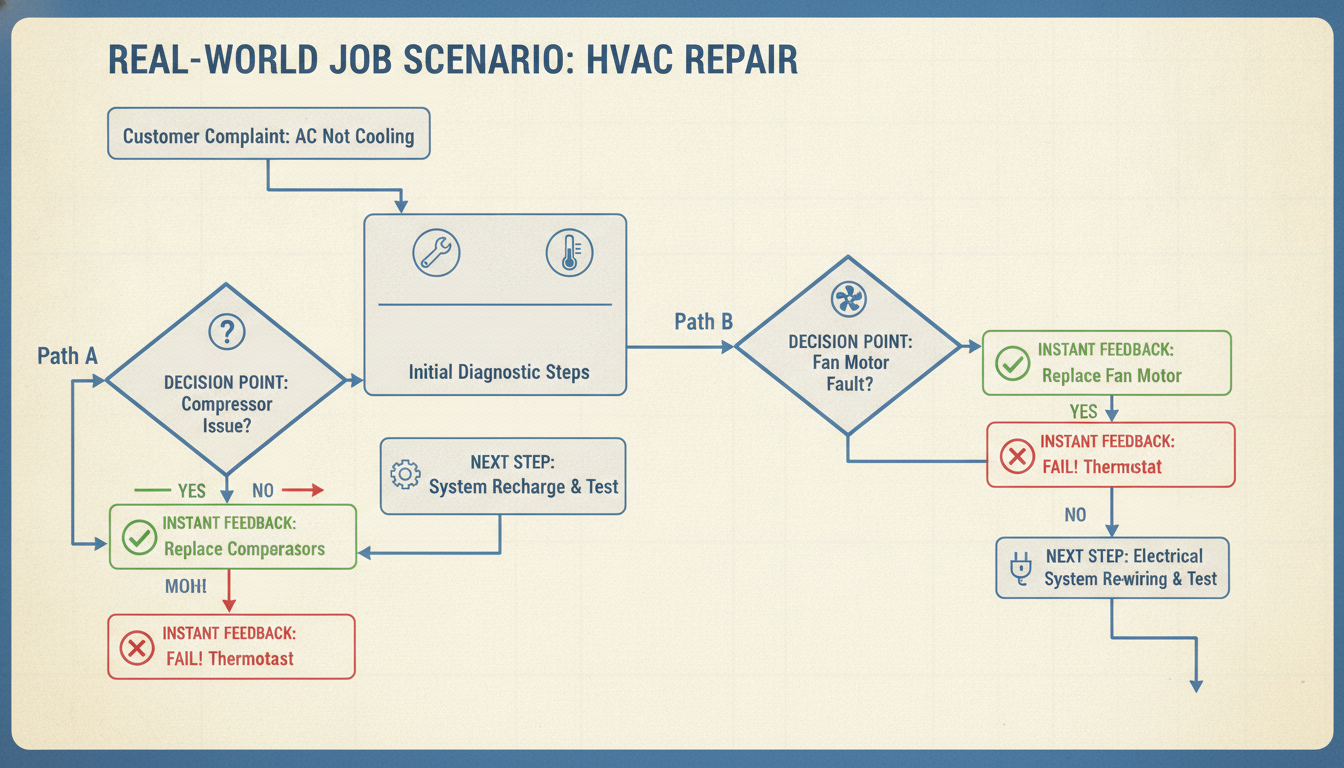
Next, if you want online CECs to feel like the field, the course has to make you do something every few minutes, not just watch and nod. A useful benchmark is frequent “choose the next step” moments, with instant feedback, so you know whether you made a call that would pass on a real job.
Start with the must-haves that translate directly to field tasks (inspection, documentation, setup, monitoring, and teardown):
Interactive simulations that mirror a job sequence (arrive, assess, act, re-check)
Annotated visuals (photos, diagrams, or short clips) that point to what matters, like moisture patterns, contamination boundaries, or equipment placement
Real-world scenarios with constraints (limited access, time pressure, customer concerns, mixed materials)
Step-by-step lessons tied to a specific task, like “set up containment” or “document readings,” not broad theory
Also, look for skills being checked in a way that is easy to understand and hard to game. Each skill should have clear pass-fail criteria so you can tell the difference between “I watched it” and “I can do it,” like choosing the right next action after a reading or identifying when to stop and re-check before moving forward.