
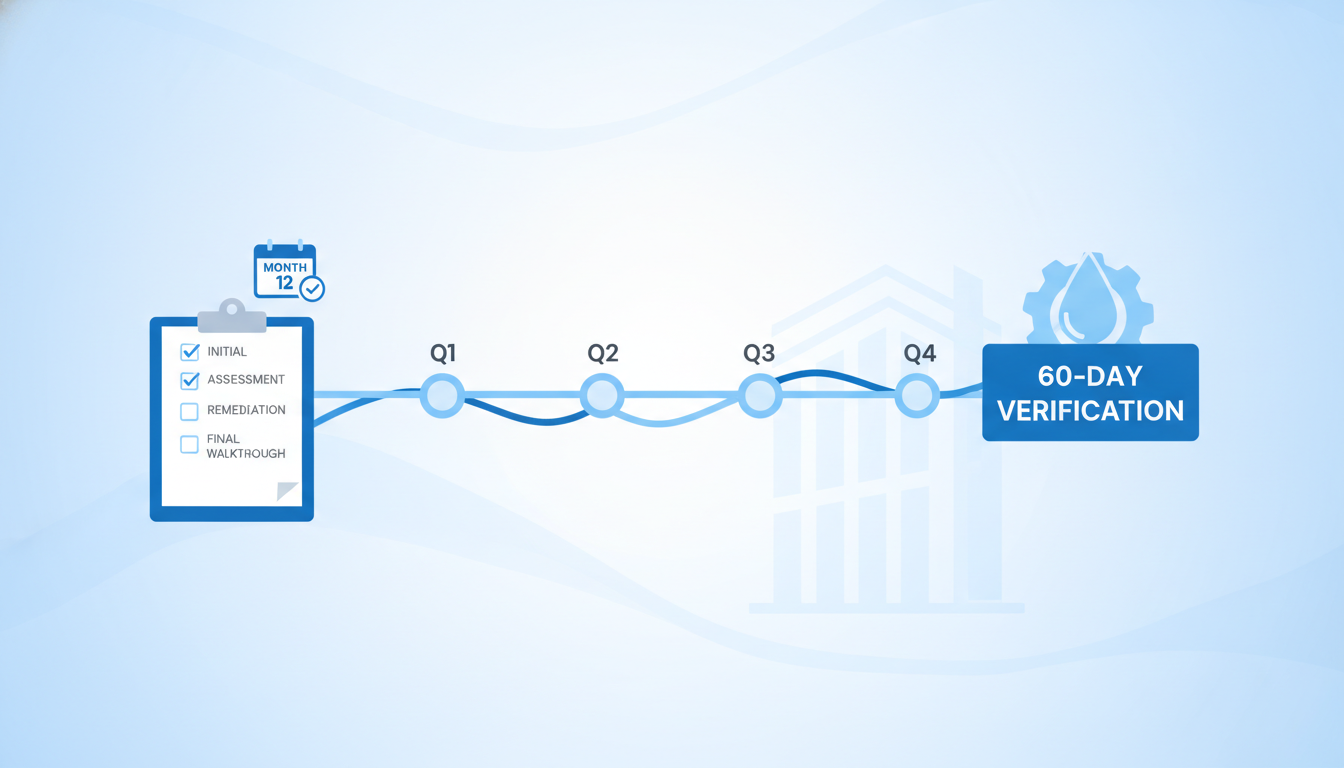
IICRC CEC Requirements for Master and Inspector Certifications (2-Year Cycle)

Aug 6 / RestoreTech 360 Team

Key Takeaways

  • Master and Inspector credentials run on a shorter renewal cycle: 14 IICRC CEC hours every two years

  • Plan CECs differently than technician certifications so you do not end up with a last-minute scramble or a lapsed credential

  • Track progress by checking your CEC status online and mapping each class or event to the right renewal deadline

Avoid renewal surprises with the two-year Master and Inspector CEC cycle

You plan your continuing education like a technician, thinking you have four years, and then an email or letter reminds you your renewal window closes in weeks. That’s when people start rushing: hunting for last-minute classes, paying more than planned, and hoping the hours reported in time.

Here’s why it happens: many Master and Inspector renewals run on a two-year clock. So for planning purposes, think 14 CEC hours per 24 months, not a four-year cycle. By the end of this section, you’ll have a simple way to map those hours across two years so you are not forced into a sprint.

If you do one thing, do this: split 14 hours into two small targets so you can recover if work gets busy. For example:

  • 7 hours in year 1 and 7 hours in year 2

  • Or 1 to 2 hours per quarter so nothing piles up

Here’s the catch: the two-year plan works best when you set a calendar reminder and log completions as you go, but it fails when you wait to “batch” hours near renewal. A common mistake is assuming completed training will show up instantly in your record; the fix is to keep a simple note with the course name, date, and hours so you can follow up if reporting lags.

Master and Inspector CEC requirements vs the standard technician cycle

Next, here’s why the Master and Inspector renewal rhythm often feels harder than the standard technician cycle: the window is shorter, the deadlines come faster, and the cost of a small slip is higher. If you are used to spreading education out over a longer period, a two-year cycle can turn “I’ll do it later” into a last-minute scramble.

A practical benchmark: in a two-year cycle, you only have about 24 months to earn what you need, submit it, and fix any issues before renewal. That tight timing increases the risk of an accidental lapse, especially if you are juggling field work, travel, or seasonal slowdowns.

What’s different in practice

The easiest way to plan is to compare the two cycles on a few points you can actually control:

  • Cycle length: Master and Inspector credentials run on a two-year renewal cycle, so your buffer is smaller if you miss a class or forget to submit proof

  • Total CECs: The total required can feel more demanding mainly because you have less time to space credits out across the cycle

  • Timing strategy: A technician might be able to stack credits later in the cycle, but Master and Inspector renewals tend to work best when you earn credits steadily, such as quarterly or every 6 months

  • Typical failure points: Last-minute course booking, waiting too long to upload completion records, and assuming a class “should count” without confirming it

If you do one thing, make your timing plan first, then pick the courses that fit it. Works best when you can commit to smaller, regular blocks of training, but it often fails when you rely on a single big push near the deadline.

Common renewal traps and quick fixes

That said, most renewal problems come from predictable process issues, not from the training itself. If you are short on time, skip trying to perfect the plan and just set two check-in dates per year to review your total and upload any missing documentation.

Common mistakes to watch for:

  • Mistake: Treating the Master and Inspector cycle like a longer technician cycle
    Fix: Plan credits across 4 to 6 smaller milestones over 24 months

  • Mistake: Completing courses but delaying submission until the end
    Fix: Upload within 7 to 14 days while details are easy to verify

  • Mistake: Not leaving time for rejected or miscategorized credits
    Fix: Leave a small buffer so you can replace credits without risking expiration

A realistic example: if you wait until the final 60 days and one course is rejected or missing documentation, you may not have enough class dates left to recover. Spreading credits across the cycle lowers that risk.

How Master tracks like MWR, MSR, and MTC can count toward your two-year total
Also, when people ask for “examples” of what counts for Master tracks, they usually mean two things: recognized credentials (like Master Water Restorer (MWR), Master Fire and Smoke Restorer (MSR), and Master Textile Cleaner (MTC)) and the learning activities behind them that produce continuing education hours.

A practical way to think about it is this: if the activity is formal training tied to your trade, has a clear topic and date, and gives you documentation you can keep for two years, it is often easier to apply toward your total than informal learning that is hard to prove later.

Next, make renewal easier by sorting everything you do into a few “buckets” the moment you complete it. If you do one thing, do this: log each activity the same day with a short description you will still understand 18 months later.

Use categories like these so your records are consistent when you total everything up:

  • Master track training: courses and classes clearly aligned to MWR, MSR, or MTC topics (water, fire and smoke, textiles)

  • Related technical refreshers: drying science, odor control, cleaning chemistry, inspection basics, safety topics that support your scope

  • Standards and documentation: recordkeeping, reporting, ethics, and job documentation processes you can describe in one sentence

  • Event-based learning: approved conferences or workshops where you can list session titles and time in seat

Common mistake: keeping only a certificate screenshot with no context. Fix: store a simple note with it that includes the date, provider, course name, and time spent so you can defend the credit if anything is questioned during renewal.

Build a two-year IICRC CEC plan you can actually follow

Next, treat your two-year cycle like a small project with dates you can see on a calendar, not a vague goal you hope to hit later.

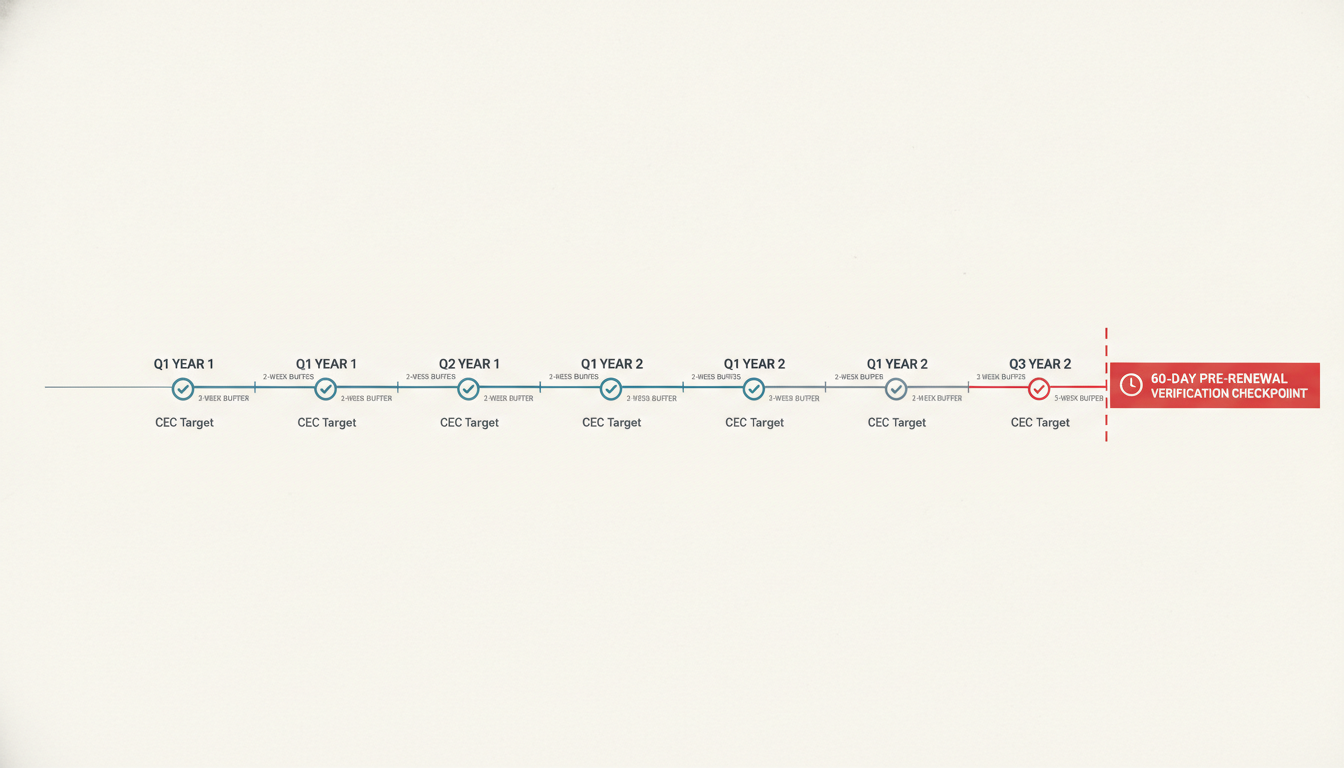
Start by setting quarterly targets (8 quarters total). If you do one thing, do this: pick a quarterly target you can repeat even during busy season, then let any extra training count as a cushion.

Use this simple schedule as your default:

  • Quarterly target: plan to earn about 1/8 of your two-year CEC total each quarter

  • Buffer weeks: add 1–2 buffer weeks after each quarter to handle reschedules, travel, or workload spikes

  • Final checkpoint: set a 60-day pre-renewal verification date to confirm your total, fix missing records, and book any last training

Common mistake: waiting until the last quarter, then finding out a class did not count the way you expected. Fix: do the 60-day check early enough to take one more approved class if needed.

Sample pacing options (pick one)

In practice, your best pacing depends on your workload pattern.

  • Steady monthly (works best when you have a predictable schedule): aim for 1/24 of your total each month (example: 60–90 minutes every few weeks, or one short class monthly)

  • Quarterly bursts (works best when you can block time): knock out 1/8 of your total in a single week each quarter, then use the buffer weeks if work runs long

  • Annual intensive plus top-up (works best when you only get one big window): complete about half your total in one annual training block (2–3 days is common), then do small top-ups every other month to stay on track

If you’re short on time, skip the perfect plan and do the quarterly target plus the 60-day verification checkpoint. That alone prevents most renewal surprises.

Check your CEC status online and choose a continuing education option

Next, treat your CEC record like a running balance, not a once-every-two-years scramble. If you wait until month 22 to check your totals, you risk missing a certificate, a course approval detail, or a simple data-entry mismatch that takes weeks to fix.

Start by logging into the IICRC portal and verifying the basics before you look at totals: your certification level (Master or Inspector), your renewal date window, and the list of courses already credited. Works best when you do this quarterly or after every class; it fails when you rely on email receipts and assume credits will post automatically.

So you stay audit-ready, keep a small, consistent evidence packet for each course you complete. The goal is to prove what you took, when you took it, and that it should count.

What to verify and save each time

  • Course title and approval details shown in the portal

  • Completion certificate showing your name and completion date

  • Provider receipt or invoice (helpful for matching records)

  • Any email confirmation that includes the course ID or approval reference

How often to reconcile records

  • If you take classes regularly: check monthly

  • If you take 1–3 classes per year: check every quarter

  • Always: check within 7–14 days after each course to confirm credits posted

That said, choosing the right continuing-education option matters as much as tracking it. With a two-year cadence, the best fit is usually the format you will actually complete on schedule, not the format that sounds ideal.

What to look for in a provider or course format

  • Clear proof of completion (instant certificate download is a plus)

  • Predictable scheduling (monthly cohorts or frequent start dates)

  • Shorter modules (for example, 1–2 hour blocks) if you are fitting training between jobs

  • Support for record questions (a real contact method when credits do not post)

If you do one thing, pick a provider you can stick with twice per year, then schedule your next course before you leave the last one. If you are short on time, skip hunting for the perfect bundle and book one approved class in the next 30 days to keep your two-year plan moving.

Closing remarks

Next, keep this simple reminder in front of you: “What gets scheduled gets renewed.” A renewal rarely fails because someone did nothing at all, it fails because the work stayed vague until the deadline was too close.

That said, treat your next renewal like a small project with checkpoints. What would change if you put two 30-minute calendar blocks on the next 24 months to check your totals, confirm what still counts, and book the next class before your schedule fills up?

FAQ

Do Master and Inspector credentials really renew on a two-year cycle instead of four years?

Yes. Master and Inspector credentials commonly follow a two-year CEC renewal cycle, which can differ from technician certifications. The safest move is to rely on your online status page for your credential-specific renewal date rather than assuming it matches a four-year cycle.

Are Master and Inspector CECs separate from technician certification renewals?

Often, yes. Master and Inspector renewals may be tracked separately from technician certifications, even if the topics overlap. Plan as if each credential has its own deadline and CEC total, then confirm how your completed courses were applied in your online account.

What’s the safest way to pace 14 CEC hours across two years?

Split it into small, scheduled blocks. A practical pace is about 7 hours per year, or 3 to 4 hours every six months. If you do one thing, book the first block early so you are not trying to complete most hours near the deadline.

How do I confirm my current CEC balance and renewal deadline online?

Log in to your certification account and view your credential status details. Check three items: renewal deadline, total CECs credited, and a course-by-course history. If you are short on time, focus on the deadline first, then confirm the credited hours.

What should I do if my records don’t match what’s shown in my online status?

First, compare course titles, dates, and credited hours against your completion certificates. Next, gather proof of completion for any missing items and contact the credentialing body or course provider to request a review. Avoid waiting, since fixes can take time near renewal periods.

Get on-schedule Master and Inspector CECs