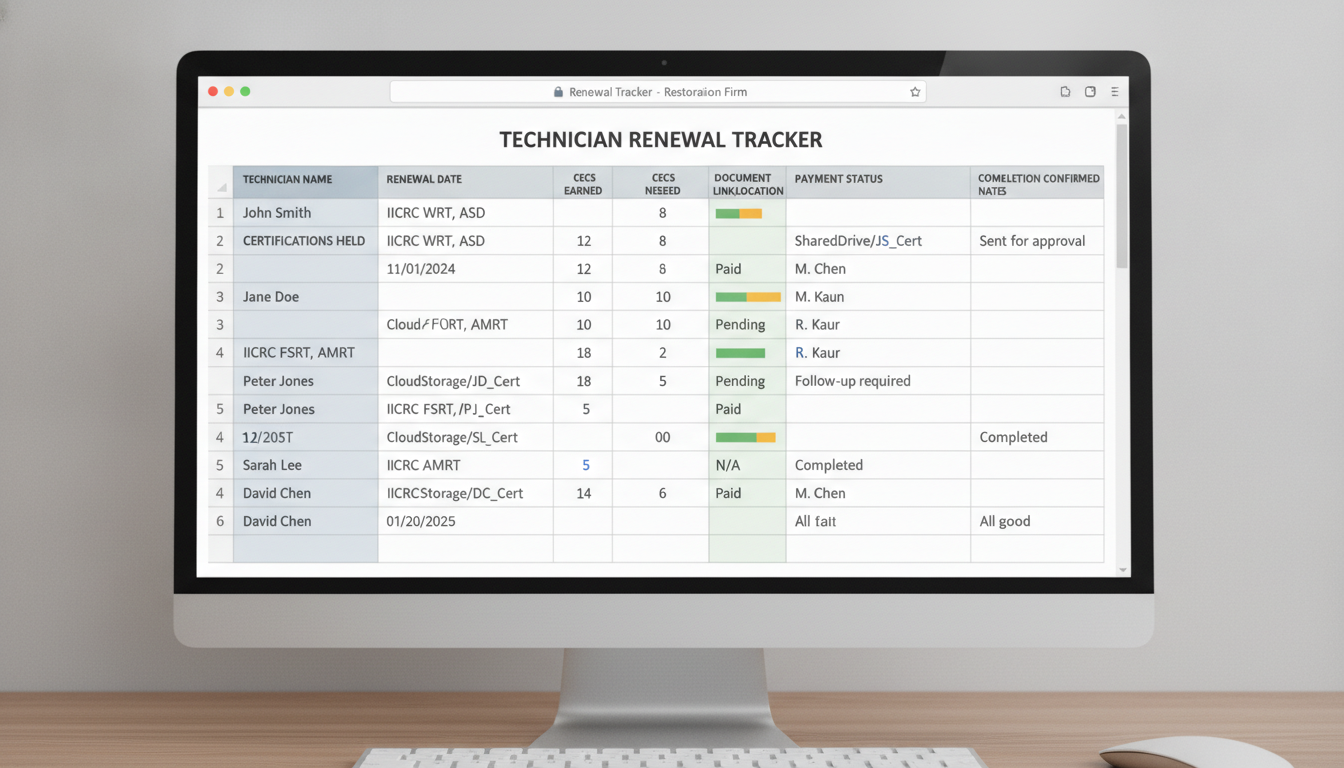
Next, picture your busy season: one technician’s renewal is due next week, another is short on Continuing Education Credits (CECs), and a third can’t find the certificate proof you need to upload or email. When renewals are spread across different months, the risk is not one big deadline, it’s a steady drip of small misses.
In firms with 5–15 technicians, a simple monthly renewal check can cut last-minute renewal fire drills by a practical 50%. The goal is to turn renewals into a routine admin task you can finish in 20–30 minutes, not a scramble that steals hours from scheduling and billing.
Here’s why a repeatable process works better than “we’ll watch the calendar”: it tracks four things at the same time, for every technician:
CEC status: earned vs still needed
Documents: certificates, course completion emails, and any required proof
Dates: renewal windows, due dates, and internal reminder dates
Payments: invoice received, paid date, and receipt saved
Common mistake: tracking only the renewal due date. Fix it by adding one internal checkpoint 30 days earlier, so you have time to find missing proof, request replacements, or schedule a course before the deadline hits.
If you do one thing, do this: assign a single owner for the monthly check, even if different techs handle their own courses. That owner’s job is not to chase people daily, it’s to run the check, flag risks, and set the next follow-up date.
If you’re short on time, skip building a perfect system this month and start with a “red/yellow/green” status for each technician:
Green: CECs and documents complete, renewal date more than 45 days out
Yellow: something pending, or renewal date within 45 days
Red: renewal date within 14 days, missing CECs or missing proof
By the end of this section, you have a repeatable admin process that tracks CEC progress, documents, dates, and payments firm-wide, without relying on anyone’s memory.