Aug 6 • RestoreTech 360 Team

IICRC CPT Continuing Education: Online CEC Credits for Contents Processing Technicians

Learn CPT continuing education vs certification, key contents skills, and earn IICRC CEC credits online with RestoreTech 360. Start today.

Key Takeaways

  • CPT continuing education is what you do after certification to renew and build on your skills and keep IICRC CEC credits current, not a replacement for getting certified

  • The most useful CPT CEC options match daily contents work like on-site assessment, pack-outs, cleaning, odor control, inventory, and documentation

  • Online CPT CEC courses can help you earn credits faster while staying available for production and field work

Keep your credential active without relearning the basics

You’re already CPT-certified, juggling pack-outs, photo logs, and customer updates, and then renewal is suddenly close. The problem is not motivation, it’s time: when you wait, you end up grabbing whatever credits are available instead of what actually helps you on real contents jobs.

A practical benchmark is to plan on 10–20 hours of coursework per year so you stay current without a last-minute scramble. By the end of this section, you’ll have a simple way to choose what to take next based on the work you actually do.

Next, treat continuing education like maintenance, not a reset of everything you learned in CPT. If you do one thing, do this: schedule 1–2 hours per month and keep a running list of job moments that felt hard, slow, or risky.

Use those moments to pick training that fills a real gap:

  • If you manage a contents line, choose courses that tighten documentation, chain of custody, and production flow

  • If you work in the field, choose courses that improve pre-inventory decisions, pack-out controls, and contamination handling

  • If you write estimates or scope jobs, choose courses that improve line-item accuracy, photo standards, and communication handoffs

Here’s the catch: the fastest path to credits is not always the best fit. “Easy credits” work best when you only need hours, but they fail when your team is dealing with repeat issues like re-cleans, missing items, or disputed inventories.

Common mistake: waiting until the renewal window and then trying to do 10–20 hours in a weekend. Fix: block two short sessions per month, and when production spikes, skip long lessons and do a single focused topic that still moves you forward.
CPT certification vs CPT continuing education

Your first CPT certification is about proving baseline competence. You learn the core terms, inspection steps, and processing workflow, then pass the requirements to earn the credential.

Continuing education is different. It’s about staying current, showing ongoing competence, and meeting renewal requirements by earning CECs (continuing education credits) in approved topics, within the required renewal window.

The most common pitfall is assuming the same training counts for everything. For example, a contents lead might retake an entry-level class they already know, but it may not match the topic area needed for renewal, or it may not be accepted.

Other common mistakes that create last-minute stress include:

  • Taking the wrong topic area for CPT renewal

  • Waiting until the final weeks of the cycle and scrambling for available hours

  • Missing documentation like completion certificates, dates, or the correct name on records

  • Assuming job experience, ride-alongs, or in-house SOP training replaces earned CECs

If you do one thing, do this: confirm the course is approved for IICRC CECs and that it fits CPT renewal before you start. If you’re short on time, focus on a course with clear proof of completion so you can file the documentation quickly and move on.

What CPT continuing education should cover for real contents jobs

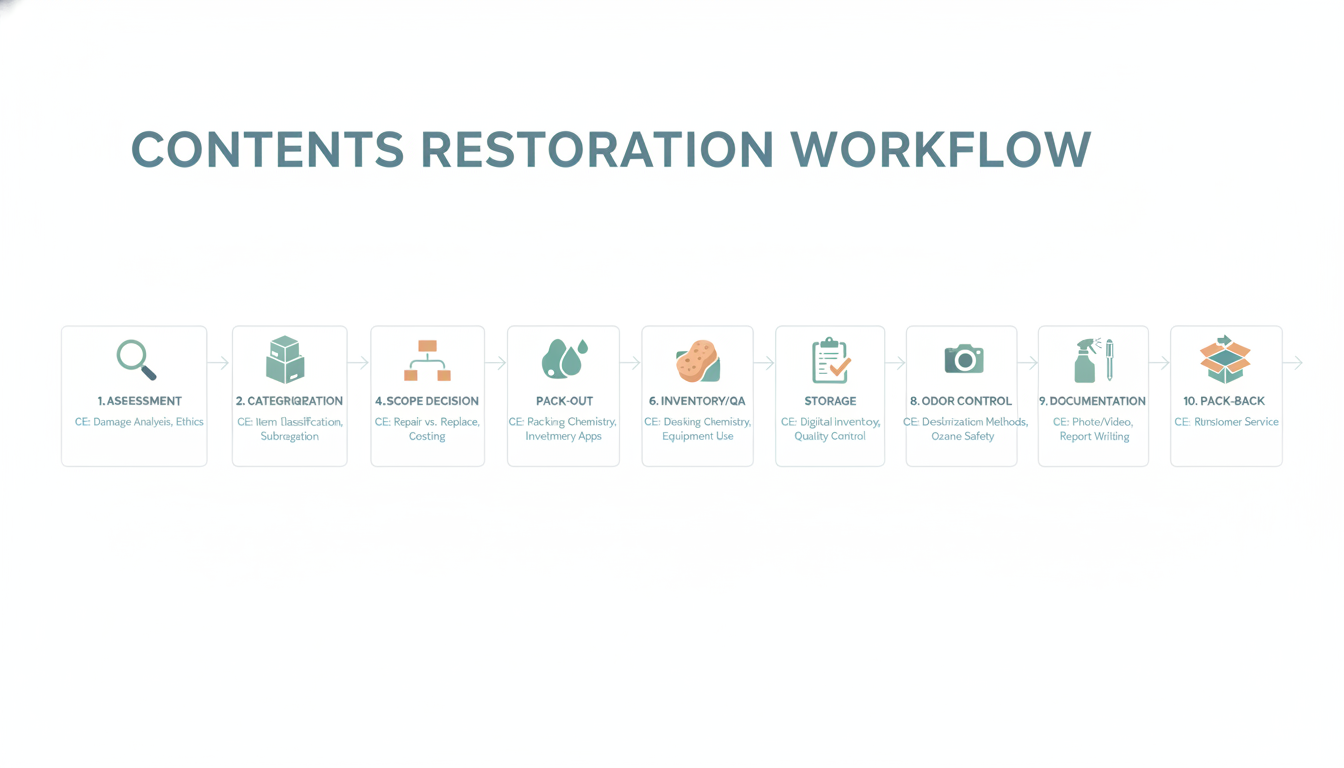
Next, pick continuing education that maps to the parts of the job that actually change production time and job cost. The fastest way to do that is to align topics to the real workflow: contents assessment, categorization, and the scope decisions that decide what gets cleaned, what gets replaced, and what gets documented.

If you only do one thing, choose CE that helps you make better go or no-go calls in the first hour on site. That is where a technician can prevent a 2-day pack-out from turning into a 4-day rework because the category, condition, or cleaning path was wrong.

Also, include high-risk areas where small misses create big callbacks, supplements, or disputes. A practical CE plan should cover:

  • Pack-out strategy: room-by-room sequencing, boxing rules, and staging that avoids double handling

  • Cleaning methods: what works best for light soil on hard goods vs what fails on porous and mixed-material items

  • Inventory accuracy: unique ID, photo standards, and QA checks that reduce missing items at pack-back

  • Odor issues: quick screening, isolation, and when deodorization is likely to fail without source removal

  • Defensible documentation: notes and photos that explain condition, decisions, and exceptions in plain language

Here’s the catch: workflow CE works best when you can apply it on the next job within 1 to 2 weeks. If you are short on time, skip broad theory and focus on one module you can turn into a checklist your team uses on the next pack-out.

How to earn IICRC CEC credits online without disrupting production

Next, treat online CECs like a production purchase, not a personal project. The goal is simple: get valid credit while building habits that reduce rework on pack-outs, cleaning, storage, and return.

A common mistake is picking a class because it looks short, then realizing the credit does not match your CPT role or the proof is hard to document. Fix that by using a quick selection checklist before you register.

Selection checklist (5 minutes before you commit):

  • Confirm the topic matches the work you actually do (contents manipulation, documentation, inventory, packing, storage)

  • Confirm the number of CEC hours you will earn and whether partial credit is allowed

  • Confirm completion requirements (quiz, final score, time-in-course, assignments)

  • Confirm how you receive proof of completion (certificate format, email vs download, name shown correctly)

  • Confirm how you will store proof internally (job folder, training folder, or HR file)

If you do one thing, do this: verify completion requirements up front. Some courses require a final quiz and a minimum score, which can turn a 2-hour module into a half-day disruption if you are surprised at the end.

In practice, the easiest way to avoid downtime is to schedule completion in predictable blocks and tie your notes to real SOP updates. Works best when you plan around your highest-volume windows; fails when you try to squeeze learning into active pack-out time.

Execution tips that keep production moving:

  • Schedule in blocks that match your shift reality (for example, two 45-minute blocks across a week instead of one long session)

  • Assign one person per week as the "CEC finisher" so the whole team is not offline at once

  • Capture notes as SOP edits: write 3 to 5 bullets you can add to your packing, labeling, and storage steps

  • Standardize photos: same angles, same distance, and a repeatable naming pattern so anyone can find the right image later

  • Standardize inventory details: model, serial, condition notes, and location fields filled the same way every time

If you're short on time, skip rewriting full SOPs during the course. Instead, mark time stamps or slide titles and make one 15-minute update after your next job closes, while the details are still fresh.

Stay certified, stay credible, stay ready

So here’s the simplest way to close the loop: Stay certified, stay credible, stay ready. When your renewal is handled on time, you protect your reputation on the job site and keep work moving when a contents claim gets complicated.

Also, take 60 seconds to check two things now: your next renewal date and the one skill area that would most improve your next contents claim. If you do one thing, put the renewal date on your calendar today, then pick a single focus area you can actually practice on the next job.

In practice, “one skill area” should be specific enough to change what you do on a Tuesday afternoon, not just what you know.

  • photo documentation that tells the story of the loss

  • packing and inventory habits that reduce reworks

  • odor control decisions that match the material and exposure time

  • cleaning method selection so you do not overwork delicate items

  • communication notes that help a PM or adjuster follow your reasoning

What’s your next renewal date, and which single skill area would most improve your next contents claim?

Earn 14 IICRC CEC hours with RestoreTech 360

Next, if you already hold an IICRC credential and you work in contents day to day, RestoreTech 360’s CPT IICRC CEC course is built for you. It’s a practical fit for working contents technicians who need continuing education credits without sitting through beginner material that does not match what you see on real losses.

A good way to decide fast: if you spend your week doing pack-outs, documentation, cleaning decisions, and re-delivery coordination, this course will feel familiar. But if you are brand new to contents work and still learning basic terminology and job flow, you will get more value from a fundamentals-first path before you chase CEC hours.

Here’s the catch: plan for about 14 hours of seat time to complete the training, then add a little buffer for note-taking and screenshots of anything you want to reference later. If you are short on time, block 60 to 90 minutes per day for 2 weeks rather than trying to finish it in one long weekend when production is busy.

What you should walk away with:

  • Clear refreshers on CPT-relevant decisions you actually make on jobs

  • Consistent terminology you can use across your team for smoother handoffs

  • A cleaner way to document what was done and why, so files are easier to defend

  • Your 14 IICRC CEC hours toward keeping your credential active

Common mistake: finishing the course but not saving proof for your own files. Fix it by keeping a simple records folder and saving:

  • Your completion certificate or proof of completion

  • The date you completed the course

  • Any confirmation emails or receipts

  • A short note about which credential the hours apply to