Aug 14 / RestoreTech 360

Resolving IICRC Renewal Online Payment Glitches and Missing CECs

Key Takeaways

  • Most IICRC renewal online payment errors come from session timeouts, browser settings, or card verification being rejected

  • You can usually fix portal glitches by ending and restarting your session, trying a different browser, and double-checking billing details and each payment step

  • Unlinked IICRC CE credits online are often resolved by matching your identifiers across systems and waiting for processing before you escalate

When your renewal is due and the portal will not take your payment

You have 10 minutes between jobs, you open the renewal portal, and the checkout spins, times out, or dumps you back to the cart. The problem is not just the lost time, it is the uncertainty of whether the payment attempt partially went through and might block your next try.

Most portals auto-timeout after about 10–20 minutes of inactivity, and that can break payment verification if the session expires mid-checkout. By the end of this section, you will have a step-by-step checklist to either finish an online renewal cleanly or document a clean support escalation.

A fast checklist to finish renewal or capture proof for support

Next, assume the portal session is the weak point and work in a tight sequence. If you do one thing, do this first: start a new session before you re-try payment, because repeated attempts inside an expired session often loop back to the cart.

Use this checklist in order (total time: about 5–12 minutes):

  • Open a fresh private/incognito window to clear old session cookies

  • Sign in and go straight to the renewal checkout without opening extra tabs

  • Avoid back button during checkout, use the portal’s own navigation

  • If you must pause, sign out and restart rather than leaving the page idle

  • Take a screenshot of the cart or renewal summary before clicking Pay

  • Click Pay once, then wait 60–90 seconds before trying again

  • If it loops back to cart, do not keep retrying, sign out and start a new session

  • Check for any on-screen message like “verification,” “processing,” or “pending” and capture it

Common mistake: rapid re-clicking Pay or opening checkout in multiple tabs. Fix: use one tab, one attempt, and restart the session between attempts so the gateway sees a clean request.

What to document if you run out of time and need support

That said, sometimes it works best when you have stable signal and uninterrupted time, and it fails when you are on spotty mobile data between job sites. If you are short on time, skip extra troubleshooting and focus on evidence that support can use to trace the payment attempt.

Capture these items before you leave the checkout:

  • Date and approximate time of the attempt (include your time zone)

  • The exact step where it fails (spinner, timeout, cart loop, error message)

  • Screenshot of the renewal cart summary and total due

  • Screenshot of the final error or the loop back to cart

  • Any reference number, transaction ID, or “pending” message shown

  • The device and browser used (for example, iPhone Safari or Windows Chrome)

Tradeoff: restarting sessions can fix checkout loops quickly, but it can hide intermittent gateway errors if you never capture the message. So, restart once or twice, then switch to documentation mode and escalate with clean details.
Fix payment gateway timeouts and checkout loops fast

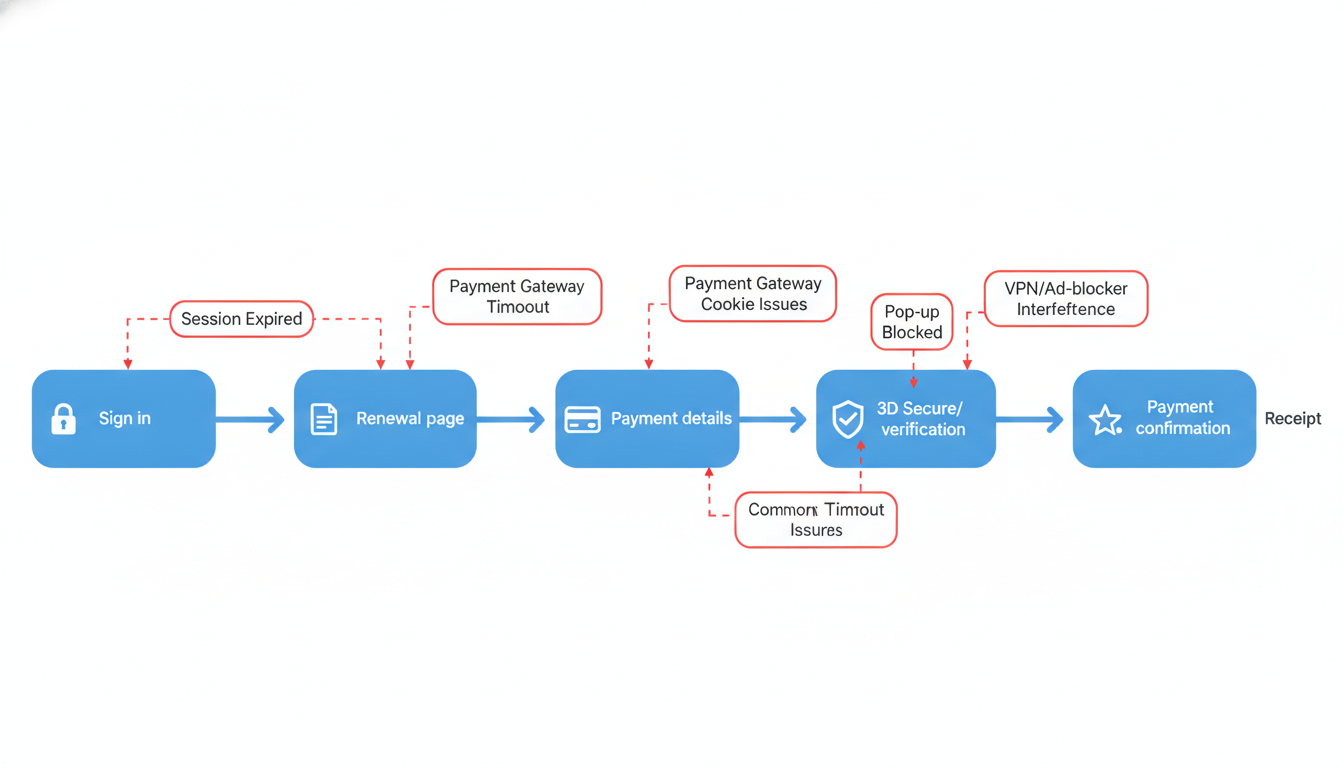
Next, treat timeouts and “send you back to checkout” loops as a session problem first, not a card problem. A fast way to confirm is to restart the entire renewal flow end-to-end so you are testing a clean attempt, not a half-saved one.

Do this restart once, step by step:

  • Sign out of the portal

  • Close all portal tabs (don’t keep the payment page open)

  • Clear the site session (cookies for the portal site, or use a private window)

  • Sign back in

  • Go back to the renewal page and re-enter the payment page from the start

If you do one thing, do the full restart above before trying multiple payments, since repeated retries can keep you stuck in the same expired session loop.

That said, if the flow still times out, remove the most common browser-level blockers. These issues show up a lot when a verification window does not open, a redirect is blocked, or a payment processor page cannot finish loading within a short time window.

Reduce common blockers and retest (10 minutes total):

  • Disable VPN, then retry the payment page

  • Pause ad-blockers or privacy extensions for the portal domain

  • Allow pop-ups and redirects (many payment steps open a verification window)

  • Try a different browser (for example, Chrome if you used Safari)

  • Try an incognito or private window to avoid cached scripts

Here’s the catch: this works best when the issue is pop-ups, cookies, or extensions, and it will fail when the portal or payment processor is having an outage. If you see the same timeout at the same step across two browsers and a private window, stop retrying and move on to card and billing checks in the next section.

Resolve card declines and billing verification mismatches

Next, treat a card decline as a data-matching problem first, not a “bad card” problem. Most renewal checkouts run an AVS check (Address Verification Service), which compares the billing name, street address, ZIP, and sometimes phone number to what your card issuer has on file.

Start by verifying every billing field exactly as your bank records it. Small differences can trigger a mismatch, especially if your issuer stores a shortened street name, an old ZIP+4, or a different name format.

  • Use the exact cardholder name on the account (middle initial and suffix if your bank uses it)

  • Enter the billing street address line exactly (avoid adding extra apartment labels if your bank does not store them)

  • Confirm ZIP and state match the issuer record (including ZIP+4 if your issuer requires it)

  • Use the cardholder phone number tied to the account, not the office main line

  • If the checkout has both “contact” and “billing” fields, make sure the billing fields match the card record

That said, once your billing details match, move to controlled alternatives so you only change one variable at a time. This helps you avoid repeating the same mismatch and makes it easier to spot what fixed it.

  • Try a different card type (for example, switch from debit to credit or from one network to another)

  • Remove autofill and retype billing details manually, especially the street line and ZIP

  • Avoid copy-paste for address fields since extra spaces can cause a mismatch

  • Confirm your bank’s fraud prompt if it appears (some issuers require you to approve the charge in an app or via text)

Common mistake: retrying the payment 5 to 10 times in a row with the same saved details. Fix: make one change, try once, then pause briefly before the next attempt so you do not trigger extra fraud checks.

Troubleshoot unlinked CEC certificates and missing course credit

Next, assume the course is completed but the portal still shows 0 CECs or the certificate is not connected to your record. Most cases come down to identity fields not matching exactly, or the sync just needing time.

If you do one thing, do this: make your identity fields identical everywhere you might have entered them. A single mismatch like “Mike” vs “Michael,” a second email address, or a missing certification number can prevent the course credit from attaching to your profile.

Here’s a fast identity checklist to run in 10 minutes:

  • Compare the name format used on the course completion certificate to your portal profile (middle initial, hyphenated last name, suffix)

  • Confirm you used the same email address for the course login and the portal profile

  • Check that your certification number is present and matches your portal profile exactly (including any leading zeros)

  • If your employer registered you, confirm they did not use a shared inbox or different email for enrollment

Common mistake: updating your portal email after you finish a course, then expecting older completions to follow automatically. Fix: revert to the original email long enough to sync, or ask support to link the completion to the correct profile.

That said, timing matters even when everything matches. Many systems post course credit on a delay, especially after weekends, high-volume renewal periods, or third-party provider uploads. As a practical benchmark, wait 24–72 hours after completion before you treat it as missing.

If you’re short on time and your deadline is close, skip repeated re-logins and focus on evidence you can send in one message. Compile:

  • Your payment receipt for the course (order number if available)

  • The completion certificate PDF or screenshot

  • Completion date and time shown in the course

  • A screenshot of the portal page showing missing CECs

  • The exact name, email, and certification number you want the credit linked to

Works best when you completed the course under the same profile you use for renewals. Fails when a second account exists (for example, personal email for the course and work email for the portal), because the credits can land on the wrong record.

Closing remarks

So, slow is smooth, smooth is fast. When renewal steps are failing, rushing usually creates more errors: extra logins, duplicate attempts, and missing confirmation details.

Next, pick the most fragile point in your renewal flow right now:

  • Payment checkout (timeouts, loops, no receipt)

  • Portal access (can’t sign in, session keeps expiring)

  • CEC tracking (certificate not linked, credits not showing)

That said, decide your next step before you click anything else. If the issue looks session-related, retry once with a clean session (new browser, private window, and no autofill) and stop after a single attempt.

In practice, if the problem persists, switch from retrying to documenting and escalating. Gather what support needs so you do not have to repeat the story:

  • Time of attempt and your time zone

  • Screenshot or exact error text

  • Receipt, authorization hold, or last 4 digits of the card used

  • Course completion details for any missing CECs (course name, completion date, certificate number if shown)

Keep your IICRC renewal credits and documentation organized