
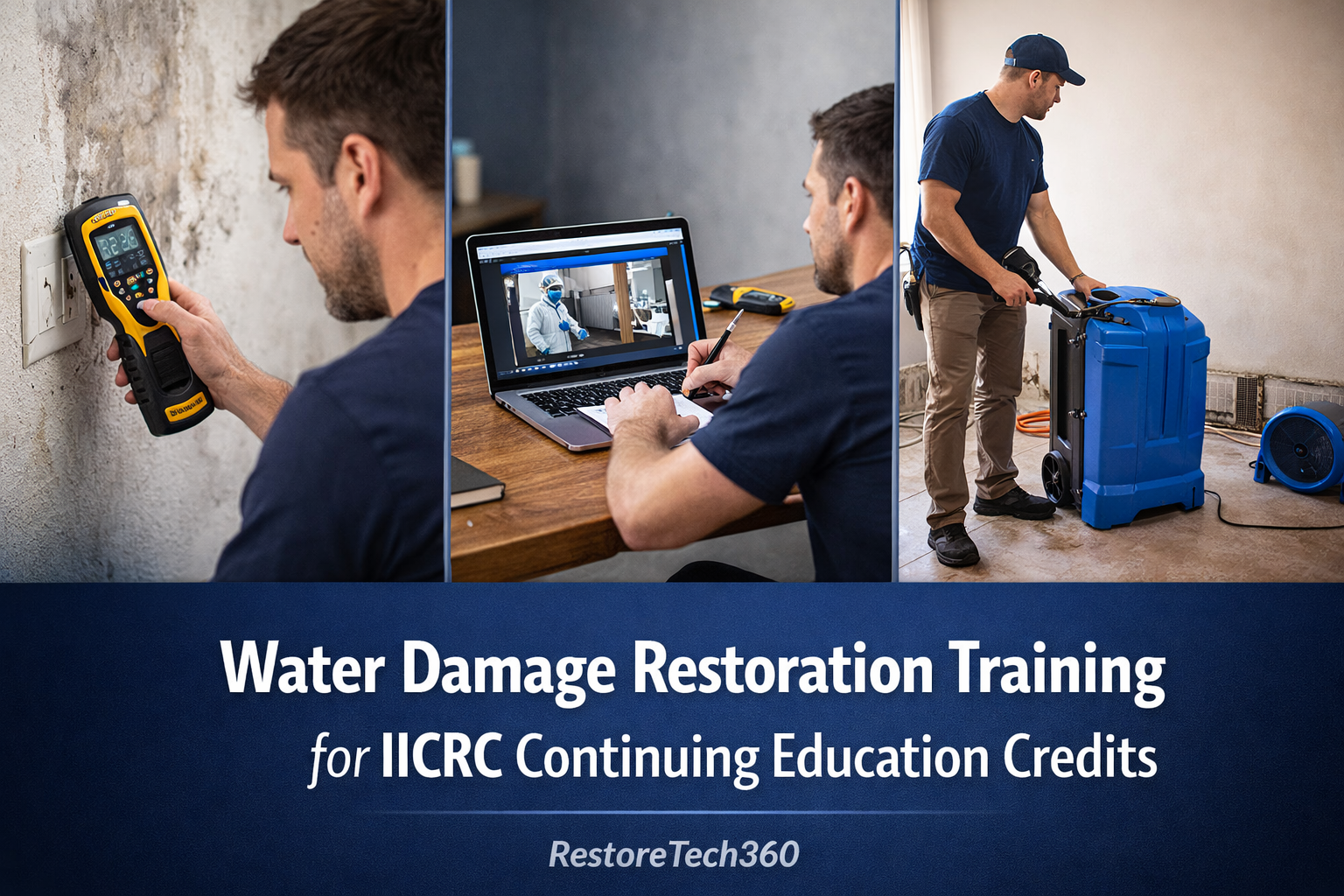
Water damage jobs move fast, and mistakes get expensive. This course-focused guide explains what “water damage restoration training” should cover, how it supports safer, more consistent job performance, and how it can contribute towards IICRC continuing education requirements when the activity is accepted as CEC credits.
You will find a clear set of learning outcomes, practical benefits for working teams, and a simple way to document your training for renewal. The goal is not theory for theory’s sake—it’s helping restoration technicians make better decisions on real water losses.
Important: CEC acceptance depends on your certification type, renewal window, and whether the training is recognised/accepted for continuing education. Always verify the details for your situation before relying on any course to meet renewal requirements.
Water Damage Restoration Training for IICRC CEC Credits
Water damage restoration is one of the most technical parts of day-to-day mitigation work. The best technicians combine speed with judgment: they inspect properly, choose the right drying approach, and document decisions clearly.
That is why water damage restoration training is an intelligent focus area when you are building skills and working towards IICRC continuing education. It connects directly to what you do on site—materials, moisture behaviour, drying physics, and contamination risk.
If you are planning your next set of CEC credits, a water-focused course is a practical option because it strengthens performance on common losses and supports consistent, standard-aligned working methods.
Why water damage training is a high-value choice
IICRC certificants are expected to maintain competency through continuing education. In practice, that means choosing learning that helps you work more safely, reduce rework, and improve job outcomes where it matters: inspections, drying strategy, and verification.
The ANSI/IICRC S500 Standard for Professional Water Damage Restoration describes a structured approach to water damage work, covering topics such as building and material science, psychrometry and drying technology, equipment and tools, inspections and pre-restoration evaluations, safety and health, and project documentation and risk management.
A course that aligns to these real-world topics is not just “credit collection”. It builds repeatable habits that help technicians justify decisions, avoid over-drying or under-drying, and recognise when a job is becoming more complex.
Key learning outcomes
In a strong water damage restoration training course, technicians should leave with capabilities they can apply immediately. Look for outcomes like these:
- Inspect and classify the loss consistently, including building/material considerations, likely moisture pathways, and what to document before drying begins.
- Use moisture data to make decisions, such as creating a simple moisture map, selecting control points, and tracking progress with repeatable measurements.
- Build a drying plan that matches the situation, choosing equipment types and quantities based on the environment, material load, and drying goals.
- Identify and manage complexity, such as when contamination risk, hidden moisture, or HVAC impacts change the approach or require escalation.
- Document work in a way that supports handover, including conditions at start, daily monitoring notes, adjustments to the plan, and end-of-job verification.
What the course should cover
A course can be “water damage training” in name only. To be genuinely useful for technicians and supervisors, the content should reflect how jobs run from first attendance through final verification.
Initial inspection and pre-restoration evaluation
Technicians need a repeatable starting routine. Training should cover how to assess affected areas, what to record immediately, and how to make sensible preliminary determinations—before equipment is moved in and the job environment changes.
Material behaviour and moisture movement
Water does not behave the same way in every assembly. Training should help technicians understand how common materials absorb, retain, and release moisture, and why that changes drying strategy and monitoring points.
Psychrometry and drying fundamentals
Drying is an applied science lesson on every job. Courses should teach technicians how temperature, humidity, and airflow interact, and how dehumidification choices and set-up affect drying rate. The aim is practical understanding that guides adjustments on day two and beyond.
Equipment selection, placement, and verification
Equipment is not a checklist—it is a plan. Training should address how to select and position air movers and dehumidifiers to achieve the intended outcome, and how to verify that the set-up is doing what you expect rather than simply “running”.
Safety, health, and contamination awareness
Water damage jobs can involve contaminated sources, microbial concerns, and exposure risks. A useful course should connect safety choices to the job conditions and reinforce when you need to escalate decisions rather than improvising.
Project documentation and risk management
Technicians are often judged by their paperwork as much as their equipment. Training should show what “good documentation” looks like: clear notes, consistent readings, photographs where appropriate, and a timeline of decisions that another professional can understand.
Benefits for restoration technicians
Course-focused training offers benefits beyond renewal. When the learning is well-structured and aligned to real job tasks, it can improve both confidence and consistency across your team.
- Faster, clearer site decisions: less guesswork at the start of the job and fewer mid-project reversals.
- Better monitoring discipline: readings that actually inform action, not just “numbers on a sheet”.
- More consistent drying outcomes: an approach that reduces the chance of leaving damp materials behind.
- Improved handovers: supervisors, office staff, and clients can understand what was done and why.
- Stronger professional credibility: technicians can explain decisions using standard-aligned reasoning.
Who should take this training
This course focus is not only for new technicians. It is also valuable for experienced staff who want a structured refresher and for teams who need consistent methods across jobs.
- Water damage restoration technicians who are regularly attending mitigation jobs and want sharper inspection and drying routines.
- Team leads and supervisors who review documentation, adjust plans, and coach newer technicians on best practice.
- New starters who need a clear foundation before they are left unsupervised on active losses.
- Operations or office staff who support job documentation and want stronger technical context.
How it maps to IICRC continuing education and CEC credits
IICRC certificants are normally required to maintain their credentials through a combination of annual renewals and continuing education. IICRC’s published FAQ guidance indicates that certified technicians need 14 CEC hours every four years, while master and inspector certifications require 14 CEC hours every two years.
In general, IICRC treats continuing education as “credit hours”, and an hour of eligible training is commonly treated as one hour of continuing education. IICRC also explains that you should keep documentation and submit proof of completion when required.
This is general guidance, not legal or certification advice. Before you rely on any course for renewal, confirm (a) the course’s accepted CEC status for your certification type, (b) the number of credits awarded, and (c) your renewal window. The most reliable way to check is to use IICRC’s official continuing education search tools and your own IICRC account records.
How to apply the training on your next water loss
Course knowledge becomes valuable when it changes behaviour on site. Here is a simple way to turn training into repeatable field practice.
- Before equipment: follow an inspection routine—note affected areas, record initial readings, identify likely hidden moisture, and document baseline conditions.
- Build a plan: choose the drying approach first, then place equipment to deliver that approach (rather than placing equipment and hoping for results).
- Monitor with intent: set specific measurement points and check them on a schedule that matches the job’s risk and complexity.
- Adjust when data changes: if readings plateau, the plan should change—equipment, containment, conditions, or escalation.
- Close out cleanly: record final readings and outcomes in a way that supports confidence at handover.
Enrol on RestoreTech360
If you want a practical way to build water damage competence while working towards IICRC continuing education, start with a water damage restoration training course on RestoreTech360.
Suggested next step: enrol, complete the course in focused sessions, and save your completion documentation so you can submit it if required for renewal.
Reminder: the IICRC does not endorse specific providers, products, or offerings. Confirm accepted CEC status for your circumstances before relying on the course for renewal.
Frequently asked questions
Does water damage restoration training count towards IICRC CEC credits?
It can, provided the learning activity is accepted for the certification(s) you hold and you can document completion. Always verify accepted CEC status and credit hours before assuming it meets your renewal requirement.
How many IICRC CEC hours do technicians need?
IICRC’s published FAQ guidance indicates 14 CEC hours every four years for certified technicians, with 14 CEC hours every two years for master and inspector certifications. Requirements can change, so confirm your current requirements in your IICRC account and official guidance.
What should I keep as proof of completion?
Keep your completion certificate and any course details showing date, course title, and credit hours. Many technicians also save a screenshot of the completion status page and store the files in a dedicated “CEC renewal” folder for easy retrieval.